Some Crypto Never Imploded
The answer might be darker, and more nihilistic, than the goofy vibes around crypto suggest.

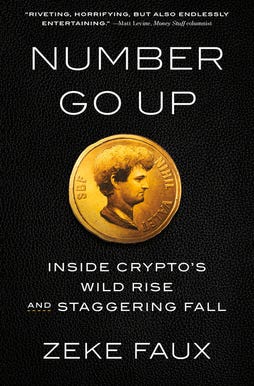
I never liked crypto, but I was still curious about why it is still around. That is why I read Number Go Up, Zeke Faux’s 2023 book about some of the pivotal moments and key personalities in crypto.
While reading it, I realised that I already knew much of the story from watching Coffeezilla, the YouTube investigative journalism channel. I do not want to bore you with the whole timeline, especially because almost everything that happens in crypto seems to be a short repeating loop of the same centuries-old investment scam: a pyramid scheme.
There are only a handful of exceptions: cryptocurrencies that have not imploded yet, despite being around for more than a decade. Maybe they never will. One of them is Tether, a stablecoin which, unlike Bitcoin, is designed to maintain a fixed exchange rate with the US dollar.
Faux repeatedly asks why Tether has not imploded. In the early chapters, he builds a case that the people behind Tether have suspicious backgrounds, and that their practices around investing customer deposits might not be so different from those of FTX, which met its demise when customers started a bank run.
Tether, however, survived the events that brought down multiple crypto companies, including Alameda Research, Celsius and FTX. Faux does not provide a clear answer as to why. But he does allude to one possible explanation in some of the final chapters of the book - and those chapters are much more interesting than the misadventures of crypto bros. They are about how Tether was used by human traffickers and online romance scammers.
I am sure you have heard of pig-butchering scams, or have at some point been approached on Instagram by an attractive stranger suddenly very interested in you. If you take the bait, they eventually present you with a lucrative investment opportunity.
Before you guess: the type of investment does not really matter, because this is not a pyramid scheme. It is a more straightforward scam where they simply take your money directly. What is interesting, however, is that, at least at the time Faux was writing his book, these scammers used Tether.
The stablecoin was used both to accept transfers from victims and for the last-mile conversion into cash, thanks to its rich and largely unregulated ecosystem. Many of the scammers Faux describes were located in Myanmar, where they laboured against their will as modern-day slaves. They were often kidnapped, or themselves deceived by fake job offers, before being trapped in closed compounds and forced to target Westerners for their dollars, euros and pounds. The victims’ money was then converted into Tether, which could be moved easily and later turned back into cash, breaking the trail of electronically traceable evidence.
How does the fact that pig-butchering call centres in Myanmar used Tether help explain why Tether stayed afloat?
Faux alludes to one possible answer: the sheer volume of hard currency being swindled through these scams may have provided enough liquidity. Tether, unlike FTX, may simply have had enough dollar reserves to honour redemptions.
I wish this had been the main topic of the book, rather than the eccentric antics and grandiose announcements of crypto bros, which occupy much of it. The theory that romance scams helped prop up Tether is compelling and certainly interesting. Yet in Number Go Up, it feels almost like a footnote, with only two short chapters devoted to it and not enough development.
Overall, I cannot quite recommend Number Go Up. It spends too much time on the superficial aspects of crypto — especially its big personalities, such as Sam Bankman-Fried, whose profile adorns the cover. What I would rather have read is a book about how abandoned casinos in Myanmar were transformed into slave-operated call centres for online scams, and what was different about Tether that made it their go-to method for moving money.